Data Governance
Overview
Data Governance is an organizational discipline that ensures data within the organization is accurate, secure, compliant, accessible, and trustworthy across its entire lifecycle. It defines the rules, responsibilities, and controls that guide how data is created, accessed, transformed, shared, and retired within an organization.
In a world driven by analytics, automation, and AI, data governance is no longer optional. It is the foundation that enables organizations to confidently use data for decision-making, regulatory reporting, and advanced technologies such as machine learning.
DataFuse AI supports modern data governance by embedding governance controls directly into data pipelines, workflows, and user interactions—ensuring governance is enforced automatically, not manually.
What Is Data Governance?
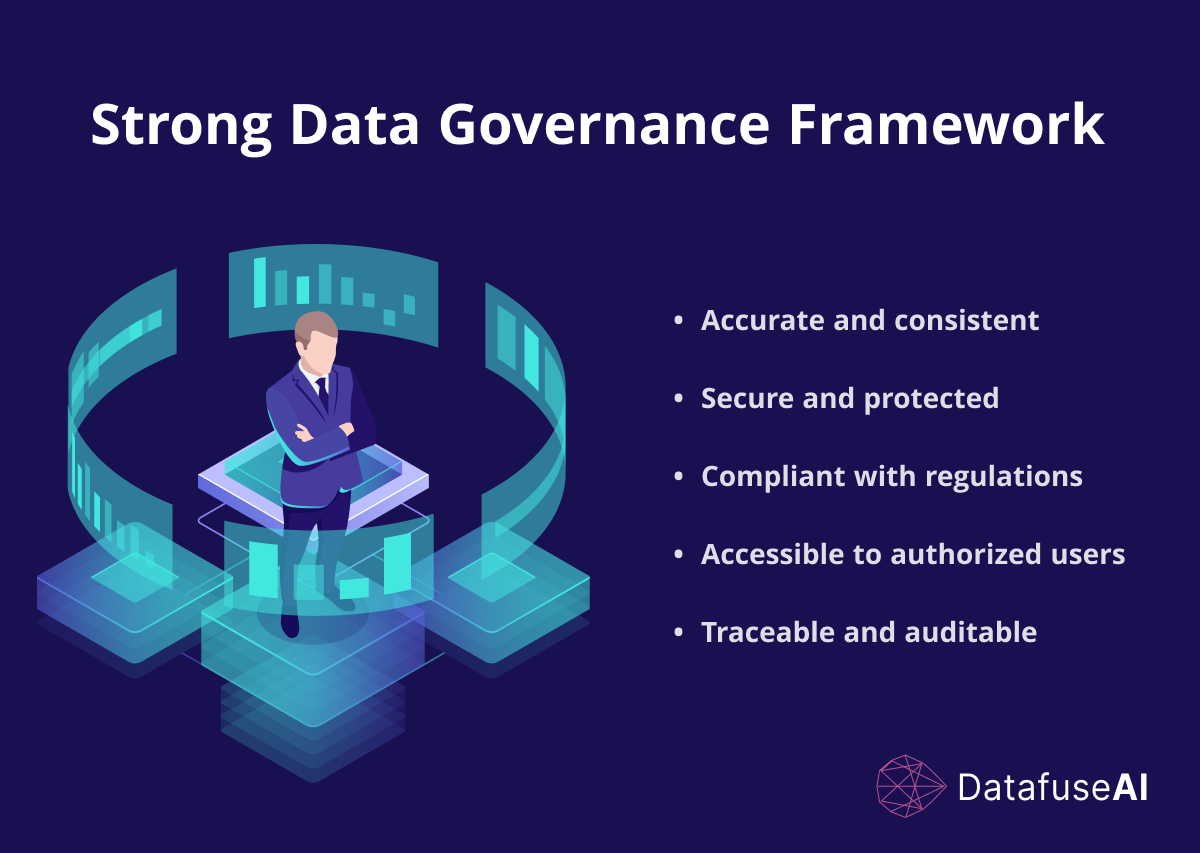
Data governance is a framework of people, processes, policies, and technologies that ensures organizational data is:
- Accurate and consistent
- Secure and protected
- Compliant with regulations
- Accessible to authorized users
- Traceable and auditable
In simple terms:
Data governance defines the rules for data. Data management executes those rules.
Without governance, data becomes unreliable, insecure, and risky. With governance, data becomes a strategic asset.
Why Data Governance Is Critical
Modern enterprises generate and consume data across:
- Databases and data lakes
- Cloud platforms
- APIs and applications
- Analytics and BI tools
- AI and ML pipelines
As data volume, variety, and velocity increase, organizations face risks such as:
- Poor data quality and inconsistent reporting
- Unauthorized access and data breaches
- Regulatory violations and fines
- Lack of trust in analytics and AI outputs
- Inability to explain or audit decisions
Data governance exists to reduce risk while increasing data value.
Data Governance vs Data Management
| Aspect | Data Governance | Data Management |
|---|---|---|
| Purpose | Defines rules, accountability, and standards | Executes technical operations |
| Focus | Quality, security, compliance | Storage, pipelines, processing |
| Questions | Who owns data? Who can access it? Why? | How is data stored and processed? |
| Nature | Strategic | Operational |
| Output | Policies, roles, controls | Systems, pipelines, analytics |
Both must work together. Governance without management is theoretical; management without governance is risky.
Objectives of Data Governance
A mature data governance program delivers the following outcomes:
- Data Quality & Reliability : Ensures accuracy, completeness, consistency, and timeliness.
- Security & Privacy Protection : Protects sensitive and regulated data through access controls, encryption, and monitoring.
- Regulatory Compliance : Supports compliance with GDPR, HIPAA, SOX, CCPA, BCBS 239, PCI DSS, and more.
- Trusted Data-Driven Decisions : Provides certified, well-defined, and traceable data for analytics and AI.
- Operational Efficiency & Scalability : Reduces rework, automates controls, and accelerates data access.
Core Components of a Data Governance Framework
A complete data governance framework is built on four pillars.
1. People – Ownership & Accountability
Defines who is responsible for data.
Key roles include:
- Chief Data Officer (CDO) – Executive ownership of data strategy and governance
- Data Governance Manager – Oversees governance execution and adoption
- Data Governance / Steering Committee – Cross-functional decision-making body
- Data Owners – Accountable for specific data domains
- Data Stewards – Maintain data quality, definitions, and policies
- Data Custodians – Implement technical controls and infrastructure
- Business Users – Consume governed data responsibly
Modern governance favors federated ownership: domains govern their data within shared enterprise standards.
2. Process – Standardized Workflows
Defines how governance operates day to day.
Core governance processes:
- Data lifecycle management (create → use → archive → delete)
- Data quality monitoring and issue resolution
- Access request and approval workflows
- Change and impact management
- Policy review and exception handling
- Audit and compliance reporting
Processes must integrate into existing data workflows to avoid friction.
3. Technology – Automation & Scale
Technology enables governance at enterprise scale.
Key capabilities include:
- Data discovery and cataloging
- Data Reshaping and Enrichment
- Metadata and business glossary management
- Data lineage tracking
- Data quality monitoring and alerts
- Role-based access control (RBAC)
- Masking, encryption, and auditing
- Monitoring and diagnostics
DataFuse AI embeds these capabilities directly into pipelines, queries, and workflows—ensuring governance is enforced automatically as data moves.
4. Policy – Rules & Standards
Policies define how data should behave.
Essential policy areas:
- Data quality standards
- Data classification
- Data ownership and stewardship
- Data lineage and traceability
- Data access and security
- Privacy and protection
- Data retention and disposal
- Data sharing and integration
- Backup and recovery
- Regulatory compliance
Policies must be practical, enforceable, and aligned with technology.
Data Governance Readiness & Maturity
Organizations assess governance maturity across four dimensions:
- People – Skills, roles, sponsorship, literacy
- Processes – Defined, repeatable, embedded workflows
- Contributors – Business and technical ownership
- Technology – Scalable platforms and automation
Maturity models help organizations:
- Identify gaps
- Prioritize initiatives
- Measure progress over time
How a Data Governance Framework Works
1. Discovery & Inventory
- Scan and connect to data sources
- Extract metadata
- Classify sensitive and regulated data
- Build lineage across pipelines
2. Policy Definition & Enforcement
- Translate policies into system rules
- Enforce access, masking, and validation automatically
3. Monitoring & Measurement
- Track data quality metrics
- Monitor access and usage
- Capture audit logs and compliance evidence
4. Continuous Improvement
- Review metrics and incidents
- Update policies and controls
- Reassess maturity periodically
Data Governance and Compliance
Data governance enables compliance by:
- Identifying regulated and sensitive data
- Controlling access and usage
- Tracking data movement and lineage
- Maintaining audit evidence
Common regulations supported by governance programs include:
- GDPR, CCPA
- HIPAA
- SOX
- BCBS 239
- PCI DSS
- CSRD
- Industry-specific mandates
DataFuse AI supports compliance through RBAC, audit logs, encryption, controlled deployments (cloud, private, on-prem), and governed data transformations.
Data Governance for AI & Machine Learning
AI systems are only as good as the data they consume.
Governed data ensures:
- High-quality training datasets
- Bias detection and prevention
- Explainability through lineage
- Privacy and regulatory compliance
- Trustworthy AI outcomes
Best practices:
- Track lineage for AI training data
- Control sensitive attributes
- Monitor outputs for bias and drift
- Document data sources and transformations
Implementing Data Governance
Step 1: Define Business Outcomes
Start with high-impact or high-risk use cases (compliance, reporting, AI).
Step 2: Inventory Data & Assign Ownership
Catalog data assets and assign owners and stewards.
Step 3: Define Baseline Policies
Focus on a small, enforceable set of policies.
Step 4: Automate Governance
Embed controls into pipelines, queries, and workflows using platforms like DataFuse AI.
Step 5: Measure, Improve, Scale
Review metrics regularly and expand governance incrementally.
Typical timelines:
- Initial value: weeks
- Departmental rollout: 3–6 months
- Enterprise maturity: 12–24 months
Common Data Governance Use Cases
- Privacy and regulatory compliance
- Secure self-service analytics
- Data discovery and literacy
- Centralized access management
- Business glossary standardization
- AI and ML readiness
Challenges in Data Governance
- Lack of executive sponsorship
- Data sprawl and shadow IT
- Poor data architecture
- Cultural resistance
- Increasing AI and access demands
Technology alone is not enough—governance requires people, process, and culture.
Best Practices for Modern Data Governance
- Start small and scale incrementally
- Automate wherever possible
- Balance access with security
- Build cross-functional teams
- Invest in data literacy
- Measure outcomes, not just policies
- Treat governance as a living program
Measuring Data Governance Success
Key indicators include:
- Data quality scores
- Policy compliance rates
- Time to data access
- Reduction in incidents
- Adoption of governed data
- Business impact (cost savings, revenue enablement)
How DataFuse AI Supports Data Governance
While data governance is a business discipline, DataFuse AI operationalizes governance by embedding controls into daily data work:
- RBAC and tenant-based access control
- Auditable pipelines, queries, and jobs
- Data quality transformations and profiling
- Secure, flexible deployment options
- Real-time monitoring and diagnostics
- Governed automation for pipelines and workflows
This approach ensures governance is always on, not an afterthought.
Conclusion
Data governance is a core enterprise capability that enables organizations to protect data, comply with regulations, and unlock business value.
When governance is embedded into data workflows—rather than enforced manually—it becomes scalable, trusted, and effective.
With DataFuse AI, governance becomes part of how data works: secure, automated, transparent, and ready for analytics and AI.